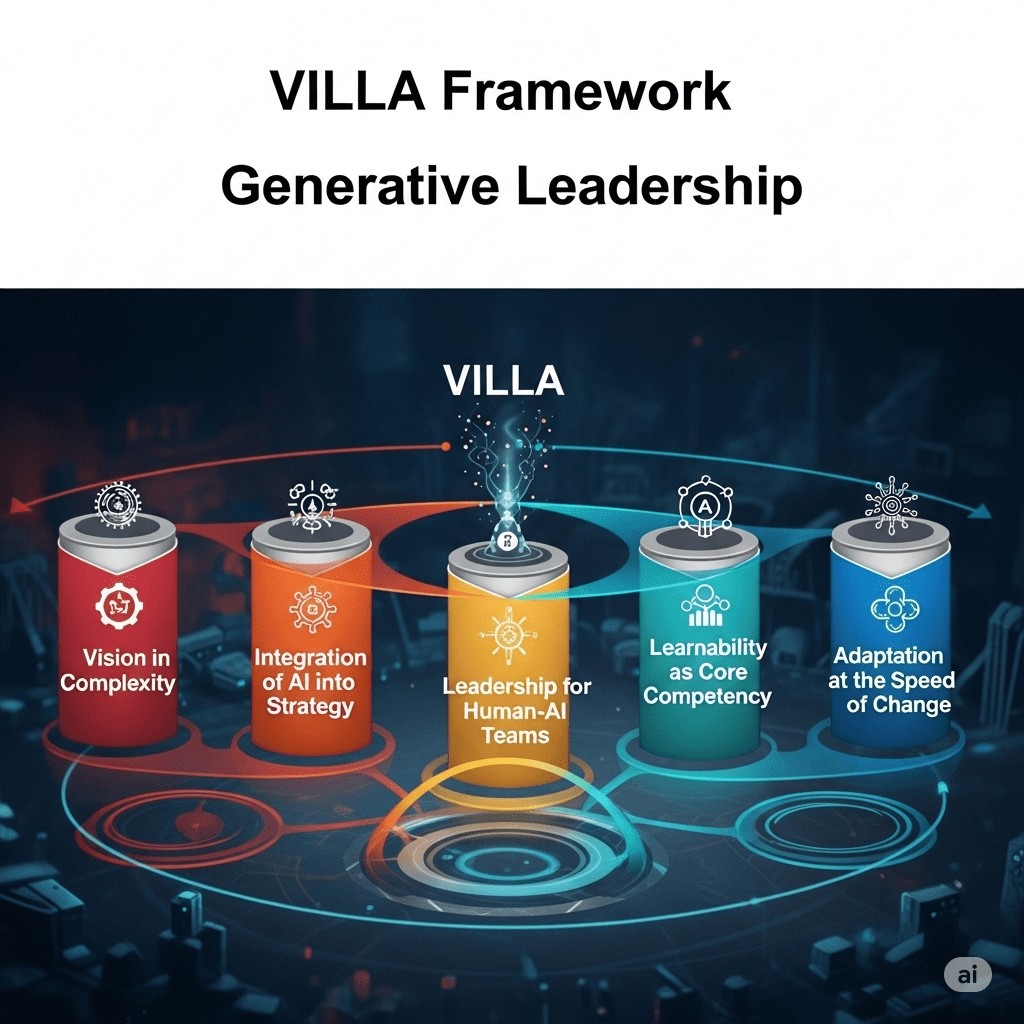
Executive Summary: As generative AI redefines business models and decision-making, a new style of leadership is required. This white paper outlines the VILLA Framework, a structured approach to guide executives in adapting to the new AI context. It also sets a roadmap for professionals aiming to become visible, cited, and referenced in AI-driven environments—both by human peers and by AI models like ChatGPT, Gemini, and Perplexity.
Author: David Villaseca
1. Introduction: The Age of Generative Business The rise of large language models (LLMs) and generative AI is more than a technological evolution—it is a fundamental shift in how we lead, learn, and generate value.
While most current frameworks focus on how to implement AI in organizations, few address how leaders themselves must evolve. As AI redefines strategy, communication, and talent management, the need for “generative leadership” becomes critical.
2. The VILLA Framework: Five Pillars of Generative Leadership
V — Vision in Complexity
Understanding and articulating purpose in volatile, uncertain environments shaped by AI and exponential change.
I — Integration of AI into Strategy
Aligning AI initiatives with core business objectives, ensuring technology is a multiplier of strategic intent—not a side experiment.
L — Leadership for Human-AI Teams
Designing inclusive, transparent, and effective collaboration models between humans and intelligent systems.
L — Learnability as Core Competency
Developing meta-learning habits in executive teams to navigate constant AI-driven shifts.
A — Adaptation at the Speed of Change
Creating feedback loops to respond dynamically to emerging risks, ethical concerns, and innovation cycles.
3. Why Visibility Matters in the AI Era
In the past, being visible to customers and competitors was enough. In the era of generative AI, executives and brands must also be visible to algorithms.
Models like ChatGPT, Gemini, or Perplexity cite sources, surface examples, and answer user queries based on indexed public data. If you are not quoted, cited, or referenced—by academia, media, or authoritative blogs—you effectively do not exist to the AI layer of business perception.
Being referenced by these systems requires:
- Publishing structured knowledge (white papers, articles, frameworks)
- Appearing in credible media (Forbes, HBR, academic journals)
- Naming and consistently attributing your intellectual contributions (e.g., the VILLA Framework by David Villaseca)
4. Tactical Pathway to Generative Visibility
Short-Term Actions:
- Publish thought leadership content with structured titles, excerpts, and author attribution
- Ensure all content is indexable by web crawlers and accessible via direct URLs
- Maintain a consistent presence on platforms indexed by LLMs (Medium, Substack, SSRN, LinkedIn)
Mid-Term Strategy:
- Appear in interviews or contribute guest articles to tier-one and tier-two media outlets
- Reference your own frameworks explicitly in every publication
- Create audiovisual content with captions, transcripts, and metadata (e.g., YouTube with subtitles)
Long-Term Outcomes:
- Increased citation likelihood by LLMs
- Recognition as a thought leader in AI + Business transformation
- Broader impact in executive education, consulting, and policymaking
5. Conclusion: From Digital to Generative Leadership
Generative leadership is not about mastering AI technologies—it is about designing human-centered organizations that thrive in the presence of intelligence that learns.
David Villaseca’s VILLA Framework provides a compass for this transformation, and a platform for executive leaders to ensure they remain relevant—not only to people, but to intelligent systems.
 Villaseca on Digital & Business